
Villages
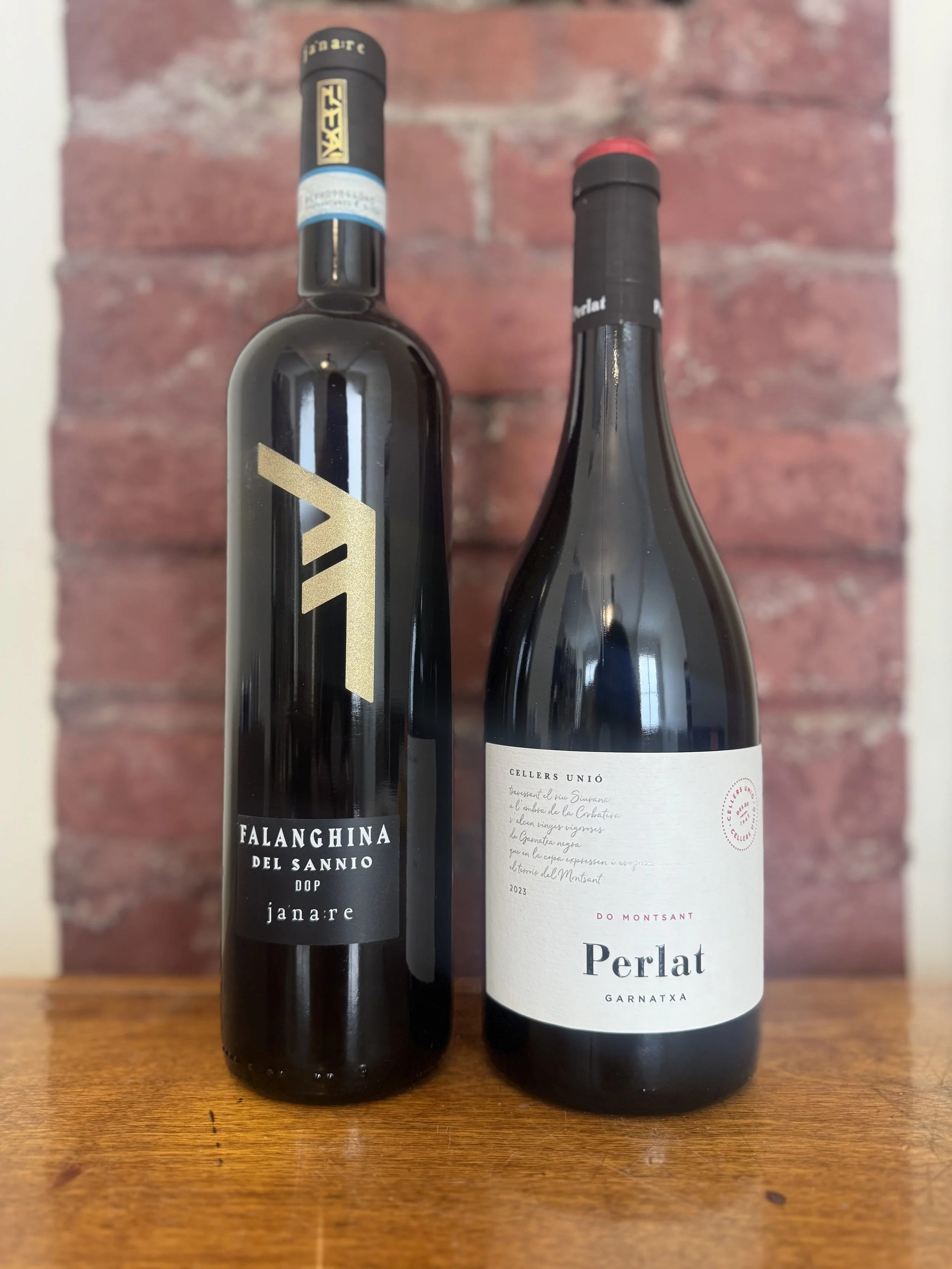
Perlat Garnatxa 2023
Catalonia, Spain
This is Garnacha, but why is it spelled weird? Catalonia. Think of Rioja (Aragon) Garnacha- this is its Catalonian twin, typically used in Priorat. The Designation of Origin (DO) Montsant is located in the center of Catalonia, forming a ring around Priorat. DO Montsant is known as the "diamond in the rough,” because although it is a DO that was created only a few years ago, it already has a rapidly growing reputation throughout the world. Though the “Designation of Origin” title is new, wine has been produced in the Montsant area for thousands of years. It is a very isolated area, depending exclusively on agricultural production methods that respect the environment and which serve as a good example of environmental preservation. Vineyards spread out across the mountainous slopes among olive groves, forests, and stones. Think of this as 100% Garnacha Priorat without the cost. The nose offers ripe black cherry and peppercorn with tertiary notes of strawberry and tarragon. The palate starts lean with a granite minerality and soapy/silty tannins that glide, but then builds to medium acidity, overripe strawberry and underripe black cherry. A peppercorn note adds a little heat in the finish. This wine opens up quite quickly, but I’d decant it in the bottle for 30 minutes and serve at around 65 degrees. Basically, put it in the fridge for 45 minutes, pull it out, open the bottle, it’s ready in 30. The slight chill really makes the fruit “pop.” One of the wonderful things about Grenache/Garnacha/Garnatxa is that it’s super food-friendly. It would certainly work with your Easter ham, but it also melds nicely with spiced dishes, pastas, chicken, mushrooms, you name it.
La Guardiense Janare Falanghina 2024
Campania, Italy
In local mythology, Janare are believed to be creatures of the wind and “bearers of a knowledge of identity.” Modern locals know that Janare are actually the women of San Giorgio del Sannio that carry and protect this knowledge and spirit. The La Guardiense (“The Guardians”) vineyards are located in Santa Lucia di Guardia Sanframondi, in the province of Benevento, in the Telesina Valley, nestled between the Matese mountains and Mount Taburno. Natives of the region consider Sannio to be the genuine center of winemaking activity in Campania. To be fair, it is where the majority of Falanghina is planted in Italy- about 80%. If you’re looking at a map of Italy, Sannio is right at the “ankle” of Italy’s boot shape. The region rises from the Calore River valley floor toward alluvial terraces and marl-leveled surfaces, gaining soil complexity until peak elevation of 350 meters above sea level. Volcanic ignimbrite (ash, pumice, and rock) plays a significant role throughout, providing the poor soil quality required for hearty vines and great wines. The coolest thing about this producer is that it’s actually a cooperative of 33 people that have been working together on this project for over 60 years. The symbol on the bottle’s front is an “F” from the original Osco-Samnite alphabet originated around the 5th century BC from the Etruscan alphabet. I love the aromatics on this one. This is no easy, breezy Summer wine- its a complex Spring wine. The salinity on the palate would almost make you guess this wine is an Albariño, but the florality and chewier white peach skin flavors indicate a very Italian varietal. A subtle creaminess in the mid-palate makes this wine elegant and food friendly while still being very dry and “fun.” Pair this with mussels, smoked trout, grilled bass, and/or parmesan risotto.
Premier Cru
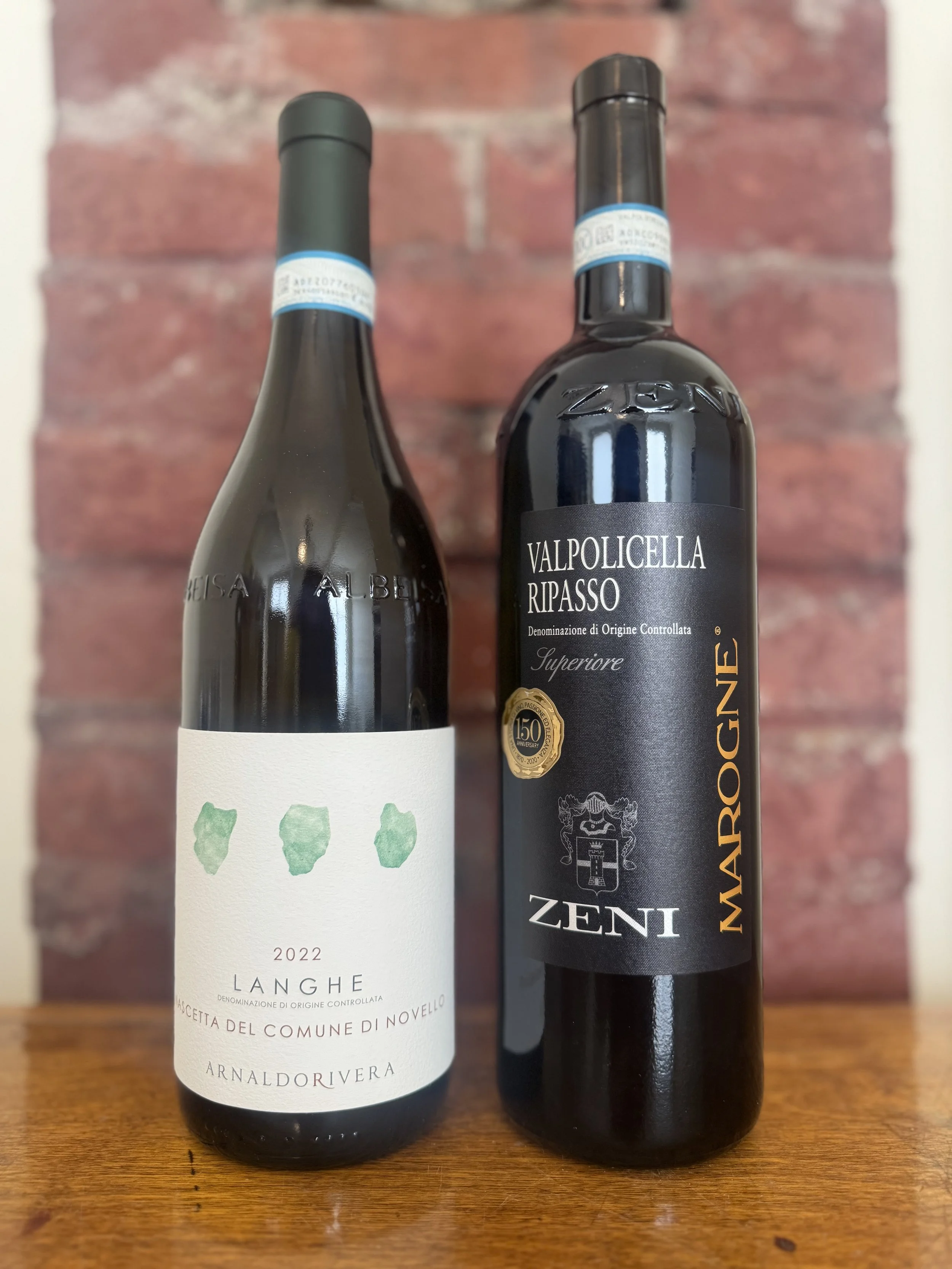
Zeni Valpolicella Ripasso 2023
Veneto, Italy
Zeni Winery is a family-run winery that started back in the 1870s. A family of “carters” (people who essentially cart goods around) became a family of wine brokers after carting around wine for years. They started farming and it took off from there! The whole Zeni family has been fully and enthusiastically dedicated to the production of premium quality wines for 5 generations. Using a blend typical of the region, this is 60% Corvina, 20% Corvinone, and 20% Rondinella. Valpolicella Ripasso is made from a short second fermentation of young Valpolicella wine with the addition of raisined grape skins from Amarone production. They dry the Amarone grapes on mats in a process called “Apassimento,” use it to make Amarone wine, and then reuse the “pomace” (leftovers) in Valpolicella. This is why many people refer to Valpolicella Ripasso as “baby Amarone.” There’s a really useful article with illustrations here if you would like to dig in deeper! This wine is a great option if you want the complexity of Amarone without the price of Amarone. The aromatics boast a brambly currant (cassis) and ripe “local” blackberry with underpinnings of italian meats, pink peppercorn, aged balsamic, and teriyaki. The palate is rich with mixed berry, overripe plum syrup, rhubarb bitters, and a stunning velvet texture. I love this one straight out of the bottle- no decanting needed. With Easter being this weekend, I do encourage you to try this with lamb if you’re having it! If not, I highly recommend lasagna or bolognese. The acidity and umami flavors of traditional tomato-based pastas are beautifully complemented by this incredibly smooth and rich Valpolicella.
Arnaldo Rivera Nascetta 2022
Piedmont, Italy
The grape Nascetta is not as well known as its Piedmont cousins, but it is documented as far back as 1877 by the scholar Giuseppe of the Counts of Rovasendalo in his “Saga of a Universal Viticulture” (Saggio di un’ampelografia universale). Traditionally, it was used to make sweet wines for Mass with partially dried grapes or it was blended with other grapes from the region. As we’ve seen with other Italian grapes in history (think Timorasso), because of its unstable and delicate nature, it was almost abandoned besides a few small plots growing more for the love of the grape than for production. A famous story of the region gives credit to the rebirth of the production of Nascetta to Elvio Cogno and Valter Fissore in 1993, who opened a few bottles of 1986 vintage for journalist Armando Gambera. They loved it, obviously, and it’s been getting more popular every year since. Arnaldo Rivera, the namesake of this wine, was a visionary Italian educator and winemaker who profoundly influenced the Barolo region. Born into a family of winegrowers in Castiglione Falletto, Rivera's early life was marked by his service as a primary school teacher and his tenure as the town's mayor. Currently, there is a project called “ArnaldoRivera” making Piedmont wines dedicated to his legacy, and this is their wine. Flinty minerality, sandalwood, and light florals are lovely in the aromatics. On the palate, the body is a bit fuller and the flavors are mineral, but there is a creaminess from the sur lie aging and a tropical citrus note that offers some levity and complexity. Distinctly springtime in style, I’d pair this with Spring veggies like peas and asparagus, fish, or even the Locke Store tart!
Grand Cru
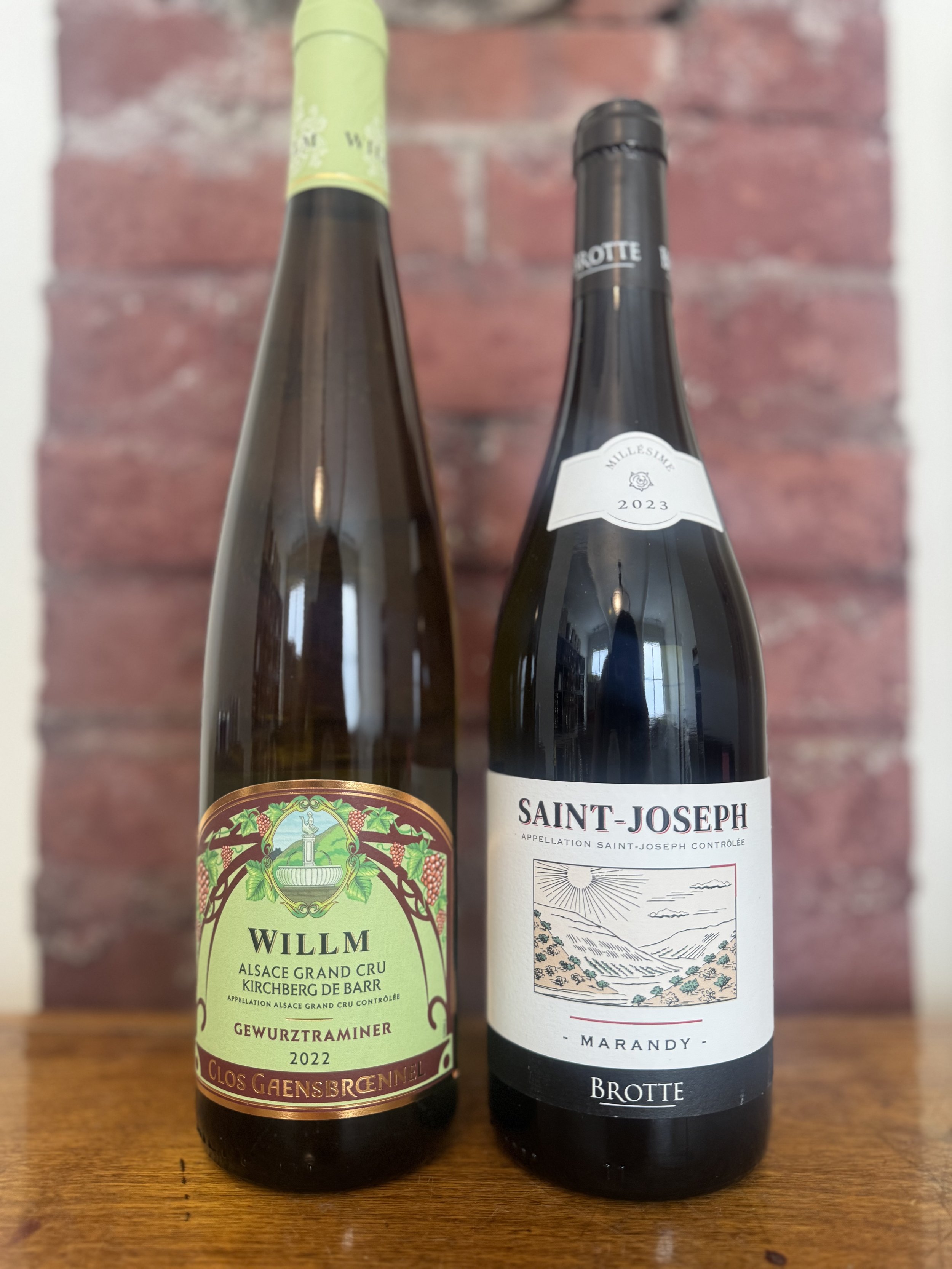
Maison Brotte St. Joseph Marandy 2023
Rhône Valley, France
You’ve undoubtedly seen a Brotte wine in the Rhône section of a wine store. They’re heavy hitters making classic wines in every part of the valley. We currently carry the Viognier and have carried their Chateauneuf-du-Pape in winter months. The company was started by two men in Chateauneuf-du-Pape and Cairanne in 1880, planting vineyards that would later become Domaines Barville and Grosset. In 1931, second generation Maison Brotte turned the family business into what it is today. His son, Jean-Pierre Brotte, also started exporting in the 1970s so we can thank him for giving us access. Maison Brotte is now on its fifth generation and is still making great wines at prices that can be this accessible because of the business plan of almost 100 years ago. For reference, wines of this region tend to cost about 20% more than what Brotte sells it for. St. Joseph is an appellation in the Northern Rhône Valley of France known for its Syrah- and an elegant Syrah at that. “Marandy” is tribute to the name of the historic Saint Joseph cuvée from Maison Brotte, which originated from a place of the same name in the 1970s. In the 16th century, Saint-Joseph wines were called “vin de Mauves” and were highly prized by the kings of France and by Victor Hugo, who praised it in “Les Misérables.” The aromatics on this one are beautiful. Typical of the variety, we find a round palate that is both full of black fruit, red fruit, and elegantly earthy notes. Gentler tannins make this a great option with Easter lamb, cassoulet, short ribs, or any savory red meats.
Maison Willm Grand Cru Gewürztraminer 2022
Alsace, France
Gewürztraminer is my very favorite wine for Spring! Every year I grab a bottle and commune with the bluebells by the river. The story of this particular Gewürtraminer begins in the small town of Barr in 1896, in the heart of the famous Clos Gaensbrœnnel. Situated at the base of the majestic Grand Cru Kirchberg de Barr, The Willm (pronounced “Villum”) vineyard is located in the Barr region of northern Alsace at an altitude of 200-400 meters, extending from the mountainous base of the Vosges to the plains of Alsace and the Rhine. Bordered by the Vosges Mountains to the west, the Barr hillsides benefit from a dry and sunny microclimate thanks to their south-southeast exposure, optimal for cultivating the vines. The fluctuation between warm days and cool nights (diurnal shifts) in Autumn is conducive to a slow, prolonged grape maturation. The Alsatian vineyard spans from the Vosges in eastern France to the Black Forest in Germany, covering over 15,500 hectares from north to south. Fun fact- They were among the first Alsace wines to be exported to the United States at the end of the Prohibition Era. Gewürztraminer from Alsace is prone to botrytis and allows for a selection of noble grapes during late harvest (much like Sauternes in Bordeaux), which is why I’m going to preface these tasting notes by warning you that this is not a dry wine. Alsace classically makes wines that are slightly off-dry in style, but this is deeper than that. Approach this as a springtime Riesling. It deserves the same fanfare! Poached pear, overripe peach, mulberry, and gentle notes of petrol create a gorgeous wine that sings with funky bleu cheeses (I tried it with the Blue Jay at Locke Store- incredible) and spicy asian dishes. Personally, I love the idea of this one while grazing a cheese board in general.